Saturday, November 30, 2013

November DNF

The Madman's Daughter (The Madman's Daughter, #1)
I had really high hopes for this one. I really did, and they managed to carry me 250 pages into the book before I finally gave up. I couldn't stand the characters, which is too bad because there were aspects of the story that I found quite intriguing. There are disturbing aspects to this one, but the characters damaged the effect for me. I feel like this is one of those books that would benefit from a complete lack of romantic plotline- at least the way the author has written it. I might pick it up again, if I think I can push through, because I am curious to see what happens.
Nov. 9-11
Dance of Shadows (Dance of Shadows, #1)
I was skeptical about this one to begin with, to be honest. By the time I got 40 pages in, I basically decided that I would read another few pages, so that I could officially call this a "DNF" (my rule is I don't get to call it that until I am a minimum of 50 pages in).  The characters were just so annoying. The narrator, Vanessa, is a dancer, and she's attending an elite academy for ballet, where her sister had disappeared three years earlier. She is a perfect dancer, and people immediately like her, or they single her out, and she just seemed to be another cliched heroine of the "only one who doesn't realise how special she is" variety. Maybe the term would be that her modesty felt forced, if not completely false. I didn't really get much further than that, just barely to the introduction of the love interest.  On whom the main character seems to develop an instant stalker-crush (do teenage girls really do that? Nobody I knew did, as far as I'm aware.) Yeegh. I'm sorry but he just struck me as so idealized/ stereotypical it was almost cliche. And Zeppelin? Really? All I can think it German war blimp whenever I read the name. There wasn't enough of an engaging story line to distract me from thoughts of the Hindenburg, so I truly believe this one wasn't for me.
November 23-24
And that concludes books that I did not finish this November. Let me know what you thought of them. Were there any books that you just couldn't finish this month? Why?

Tuesday, November 26, 2013

Review: The Chaos of Stars

The Chaos of StarsTitle: The Chaos of Stars
Author: Kierstan White
Genre: Fantasy, Urban Fantasy

Why I Read It: I have a soft spot for books involving re-imagined mythology. I was also kind of an Ancient Egypt nut as a child.

A Quick Introduction: Isadora's family takes complicated to a new level. For one thing, they've all been alive for thousands of years. They're also gods. Ancient Egyptian ones. Isadora isn't a god, and she never will be. She's a human child of Isis and Osiris, just one in a very long line. And she's sick of it. Sick of being only non-permanent thing in the house, sick of all the lies she was led to believe as a child, and especially sick of her family. She's convinced they only want her around because they need a human worshiper, and, when the chance arises, she jumps on it, taking off for San Diego. But even an ocean away from Egypt she finds new problems and challenges, and also that her family still isn't far enough away to forget.

Review: This one was alright. I wasn't crazy about it, but I didn't hate it either. I feel basically nothing for this book, except perhaps a little regret that it wasn't better.

Isadora is a character who isn't really likable per say, but she still made me empathize somewhat, even though I occasionally found her a little bit melodramatic. She's been hurt, and now she's scared of being hurt again. Having been raised by, and around, eternal, undying beings, she's all too aware that she isn't like them, that she'll die some day. This leads her to the conclusion that it isn't worth putting down roots or forming attachments, because, even if she isn't betrayed, nothing in her life is going to last forever, so why bother trying? In doing this she sets herself up for a lot of anguish, especially now that she's surrounded by normal humans, all of whom will eventually die, and who constantly remind her that nothing will last forever. She also believes herself to be essentially replaceable- her mother has a new baby whenever the latest child has grown up, Isadora spent her childhood painting the walls of her own tomb and most of her family barely gives her a passing glance. However, I still found Isadora to be petty, often selfish and downright mean sometimes. Also, kind of slow on the uptake occasionally. Simply put, she could be quite annoying.

Isadora's never really had friends, and she didn't really intend to make them either, but none the less, she does make a couple, and they start to bring he out of her somewhat bitter, angry shell a little bit. There is romance in the book, and I didn't mind the love interest, though he did seem a little too perfect. Isadora is quite violently opposed to romantic relationships, because she views them as painfully temporary. There were times that the characters felt a little forced, and I didn't really find myself drawn into the story.

I'm usually pretty open to new interpretations of the gods, but for some reason I felt like these didn't ring true. I'm not sure why that was, but they just didn't feel right. The motives of the evildoers seemed kind of shallow and contrived. It didn't seem to fit well with the ambiguity that exists in Egyptian mythology, or the way the characters were established in said mythology.It wasn't that this couldn't be an interpretation, it just lacked the rich complexity that exists in Egyptian mythology.There was very little in the way of world building, and the plot didn't really develop until the last fifty pages or so, wherein the climax was a let down.

To conclude, this book had quite a few flaws to it that stopped me from enjoying it as much as I had hoped it would.

Saturday, November 23, 2013

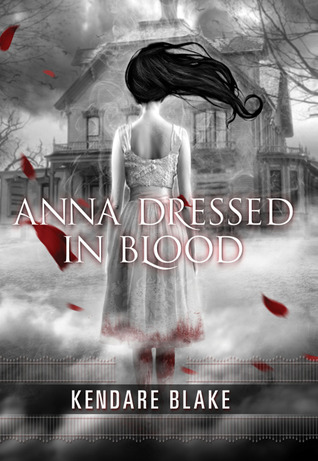
Review: Anna Dressed in Blood

Anna Dressed in Blood (Anna, #1)
Title: Anna Dressed in Blood
Author: Kendare Blake
Series: Anna
Volume: 1
Genre: paranormal, horror, romance

Why I Read It: I've been meaning to for a while. It is my first real foray into anything labeled as "horror" in a while.

A Quick Introduction: Cas Lowood kills ghosts. He's moved around since he was little, and, after his father died on a hunt, he took up the mantle, and the ghost-killing knife. He only ever stays in one place long enough to kill whatever's killing people- and there's plenty more where that came from. When one of his network of informants send him a tip about a ghost killing people in Thunder Bay, Ontario, it is with some skepticism that he heads up to check it out. Anna Dressed in Blood is a ghost in the form of a teenage girl in a bloodstained white dress, stained from the wound that sliced her throat open. When Cas arrives, he doesn't expect to find anything, since most ghost stories are just that- stories. But there is something in that house. Something unnaturally strong, even for a ghost, capable of tearing a human in half. Something that, for some mysterious reason, didn't kill Cas when she had the chance.

Review: I enjoyed this one a lot. As I mentioned I haven't really read much in the way of horror, and this seemed like a good place to start. There was one part that I genuinely found creepy (spoiler: the "In your attic eating cats" bit). I enjoyed the amount of action that there was in this one, as well- Cas hunts ghosts, which is inherently rather violent job. These ghosts, depending on their strength are fully capable of killing people and that's where Cas comes in. He hunts down the spirits that are killing people, and, using his ghost-killing athame, sends them "on". Nobody really knows where that is, and the question is raised as to what happens to the ghosts after he ends them, though it isn't answered in the book. He's used to fighting, used to hunting and constantly on the move. He's always on edge, because hunting ghosts keeps you on your toes, and, at the start of the book, views himself as above others his age, because he isn't like them. He's seen more, he's done more, and he has is purpose. Everything else is just excess baggage.

He moves around a lot only staying in one place as long as it takes to kill the ghost haunting it, and never really puts down roots in one place, so there are gaps in his knowledge of people- he's typically quite good at manipulating people to get information, but he doesn't have much experience in actually friendships, so watching him fumble through anything in the way of actual emotional connection was sort of fun. This is the first time he's really had friends, and Thomas and Carmel were good side characters. They both contribute to the story in their own ways, both to the action part of the plot line, and the more character development part, as Cas learns to trust them and they go from people who he can't seem to get rid of to friends who he trusts. I found Cas's relationship with Anna was subtler that a lot of relationships in young adult paranormal fiction (for much of the book, it was less of a driving plot point, if only simply because he doesn't realise why he's so protective of her). Anna herself was interesting as well. She's not your ordinary murderous spirit. For one thing, she's stronger, strong enough to tear a person in half, and fully capable of killing anyone who enters their house, ghost hunter or not. But she doesn't kill Cas, even though he's come to destroy her, because, for some reason, she doesn't have to, and neither of them really know why. And when she's not in her murderous rages, she's a girl trapped in her house with the corpses of all the people that she's killed. She's split into these two halves, the murdering monster, and the lost sixteen year old girl, who can think and reason. And, for the first time, he's found a ghost that he's not sure he should, or even can, kill.

So overall, I enjoyed this one. I think there was less of the "horror" aspect than I was expecting, but there were still some creepy scenes (I redirect you to the cat tail scene, for those who've read the book). I have since read the second in the duology, Girl of Nightmares, and I enjoyed that one as well, though I think I like Anna Dressed In Blood best of the two.

Thursday, November 14, 2013

Thoughts On: Reading for School

I assume everyone had to read in English class in high school (or whatever the equivalent in your country is). I also assume that, unless you had an unusually progressive teacher and curriculum, this was probably less fun than reading on you own time because you wanted to.

This is going to be a long ramble about my high school reading for my English classes. We were supposed to read one Shakespeare play every year, which wasn't too bad. It stretch you thinking (I was in an experimental program for tenth grade English, and I didn't have to do it that year). I do wish that we might have actually seen one play at some point, the way that it was meant to be seen. I don't really have a problem with reading Shakespeare. The problem for me was the novels, or specifically, one novel.

In grade eleven we read the Kite Runner by Khaled Hosseini. To summarize how I felt, and still feel, about that book, I can use three simple words: I. HATED. IT. I was miserable reading it and found it pretty traumatic, but not in any impactful way (more on that later). I don't think that it is a spoiler to say that this book discusses rape very near its start and is meant to be a redemption story- the narrator saw it happen and didn't do anything. I thinking there are a couple reasons why I really didn't enjoy this book:

  1. The narrator didn't interest me. The only reason that I really kept reading was because I had to finished my assigned pages for class. I know that I skimmed a lot toward the end, just so I could pretend that I read it.
  2. The subject matter disturbed me. If you look at my reviews, you'll see that I don't read books about rape. I just can't. I don't have that sort of emotional maturity, I suppose. They actually had to send a waiver home saying that, if this book caused the child to be scarred, it wasn't the school's fault. Should you really be making a bunch of sixteen year-olds read it then? I'm not saying ban it, I'm thoroughly against that, but maybe don't make it required material. There was an alternate option, but I was told that I wouldn't be able to participate in class at all, and that I would still have to be present for the discussions. I refused to take the book into my room. I might have overreacted, but, like I said the content was disturbing for me.
  3. I found the book relentlessly depressing. It is supposed to be a redemption story, but I didn't really feel that much redemption happened. It didn't leave a positive impact in me, and, while the ending felt like there was intended to be some sort of hope, I didn't feel it. It was in a couple scenes horrifying, and otherwise simply unenjoyable to read, to the point where I stopped being emotionally impacted by anything that happened.
You'll notice these are personal reasons for me. Reason's I didn't like the book, personally, but I also feel that there is a wider issue here: English teachers seem to think that teenagers should not read books written for their age group. I don't know why this is, but they just don't. I feel like the young adult genre gets a bad reputation for being poorly written and having no message, which, anyone who reads a lot could tell you, is not true.

These are books that are written for teenagers, with a mind to their world and emotional climate (does that make sense). They are written to be read by young adults (though they can totally be enjoyed by adults too). There are a lot of young adult books that could be inserted into a class medium and used to teach. There are plenty of young adult books that discuss a plethora of issues in a way that might, at the very least, be slightly funner than eating worms, and even possibly- gasp- enjoyable for students. I shall even make a list of books that can be used easily in teaching (with the high school curriculum of my area in mind).

Grades Nine and Ten: Exploring Heroes and the Heroic Journey


Dark Life (Dark Life, #1)Airborn (Matt Cruse, #1)Leviathan (Leviathan #1)VesselSeraphina (Seraphina, #1)The SupernaturalistThe Scorpio Races
Look! Young adult adventure stories! Heroic protagonists of various types going on quests and overcoming prejudice (and usually both)! Take notes, this will be on the test.

Grade Eleven and Twelve: Tragic Heroes and Antiheroes (and I've thrown moral ambiguity in too)
All Our Yesterdays (All Our Yesterdays #1)The 100 (The Hundred, #1)
These two. I think All Our Yesterdays actually provides a good example of the tragic hero (James- if you look for it, you will see it) as well as consequences. The 100 is something that I think would be good for discussing all sorts of ethics, morals, consequences and what makes a hero (or antihero, or villain).  Basically, I think that they could prompt discussion about real world topics and issues.

Those are some that I have been thinking about recently. There are a lot of books that could be used the the "heroism" area. I'm sure there are others for the "tragic hero" area, but All Our Yesterdays has been floating around in the back of my head for a while (it seriously does not need a sequel by the way). Those are just some ideas, and I'm sure there are books that would fit better. Not really the point.

The point is that schools should stop avoiding letting young adults read books written for a young adult audience. They do have meaning, they do have messages and many can stand up to analysis. The way English it taught now, it is just going to scare students off of reading, since it is often depressing material. So stop viewing it as some inferior form of literature, and look at possibly making use of the material instead.

Wow, that got long. If you're still here, thanks for reading my ramblings. What did you read/are you reading in high school. What do you think of the books that I have brainstormed here? Do you have any ideas? Let me know what you think in the comments.

Tuesday, November 12, 2013

Review: The 100

The 100 (The Hundred, #1)Title: The 100
Author: Kass Morgan
Series: The Hundred
Volume: 1

Why I Read It: Dystopian science fiction, which sounded up my alley.

A Quick Introduction: Three hundred years ago, humanity was devastated by a nuclear war that left planet Earth uninhabitable. The remaining humans fled to space, living in ships far above the radioactive surface of the planet. Now, one hundred juvenile delinquents, are being sent to Earth's surface to recolonize. Clarke was arrested for treason, but they don't know the worst of it. Wells committed an infraction in hopes of follow the girl he loves, especially because since it's his fault she's been sent there. Bellamy fought his way on to protect his sister, and Glass managed to escape back onto the ship, only to find out that she is no safer there.

What I Thought: I could not put this one down. I started it this morning, meaning to read a couple of chapters, and I didn't put it down until I finished it three and a half hours later. It is told in alternate points of view, between the four main characters, and that itself made it really difficult to put down. I was surprised how much I felt for the characters at times. They are all being haunted by choices they made, and everyone has a secret (or several). Some of which only come to light in the last few pages of the book. And these are big, dark, deadly secrets. The characters felt very real in their struggles in that respect- the choices they had made were probably not very good ones on some cases, and sometimes, even the right choice came with its own baggage. We only gradually find out the character's back stories, most chapters have some flashback, which is in a different font. I feel like the flashbacks really let the reader get to know the characters, and we constantly learn new things about them, both in the present and the past, some flashbacks lead to complete character reevaluations (I don't think it is a spoiler to say this: what Wells did in the last few pages, for example).

The decision that haunts Clarke so much is something that really intrigued me the most, I think. Were I in an English course, I would love to read this- there's so much material that could be analyzed in the character's stories and the way that the world of the ship is structured, especially with the revelations toward the end. Does anyone else think that this could be used in the English curriculum? There are a lot of issues that exist in the real, modern world that are addressed or mentioned in the book, as well.

For me, this book was driven more by the characters than by the plot, though it was interesting. I did call a lot of the plot twists, but mostly because, at least for the ones in the middle of of the book, and the revelations, like why Glass was arrested, and why Bellamy's sister Olivia had been confined had a good deal of foreshadowing. The storytelling in this book was fast paced, but also very well paced. As for the revelation at the end, about the apple trees (that's non-spoiler-y enough, since it only makes sense in context) was something that I suspected pretty early in the book, it almost felt foreshadowed.

All in all, this book was marvelous, not perfect, but I really, really liked it. I think it might be in my top ten reads this year. Definitely the top twenty. I'm looking forward to more from this series.

Wednesday, November 6, 2013

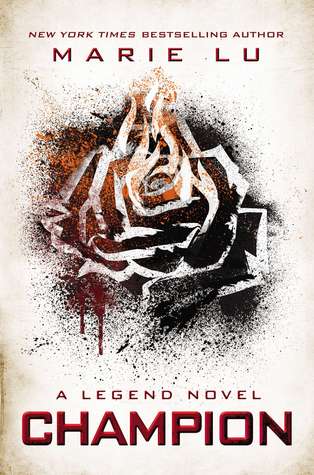
Review: Champion

Champion (Legend, #3)Title: Champion
Author: Marie Lu
Series: Legend
Volume: 3 (final book)
Genre: dystopian, science fiction, romance

Why I Read It: This is the final book in the Legend trilogy, so I have really been looking forward to the release.

A Quick Introduction (spoilers for Legend and Prodigy): June and Day have lost a lot for the Republic- family, friends and now each other. Day is racing the clock, with doctor trying to find a way to operate on the tumor in his brain, a parting gift of the experimentation he underwent years ago against his will. June is back to being the Republic's golden girl, and is being groomed to be a senator. The young Elector is attempting to negotiate a treaty with the Colonies, with whom they've been at war for years. But just as things are starting to look up, a bioengineered plague threaten's everything they've worked for, and soon Day and June are pulled back into a battle for the Republic's survival. A battle that, in order to win, they might have to give up everything that they still hold dear.

What I Thought: Well, before getting into the content of the book, let me just say that the cover is beautiful. Actually, so are the covers for the rest of the trilogy, but I think this cover is my favourite.

Okay, so on to the actual content. I actually finished this book yesterday, but what with some other stuff that I had to do, I didn't get a review in. I enjoyed this one. Some time has passed between the end of Prodigy and the beginning of Champion (eight months). Day's brother, Eden, is recovering, though his eye sight is still very poor, and Day himself is in pretty bad shape. He has constant headaches, and sometime episodes where he is in debilitating agony. He and June haven't spoken since he left without telling her that he was dying, and it weighs on both of them, and there's clearly some tension there. June is struggling with her new role as Princeps Elect, since most of the senate doesn't respect her, and the Elector has just requested the she make a morally troubling decision- that she manipulate Day.

I think the characters seem older in this book than they did in the others. In Legend they seemed a lot more like kids, but now they've both suffered a lot, and have been forced to make choices that still weigh on them. They both seemed sort of weary, I suppose, and just when things were looking up for the Republic everything goes down hill, and they get dragged back into the middle of things. June herself is in a position she isn't comfortable with, and Day is getting sicker. Their relationship with each other was kind of stop-and-go in this book and there was a lot of sadness in it this time around, with everything that was going on.

I found some of the action sequences hard to follow, but I'm not sure if it was how they were written, or if I personally didn't follow them very well. This trilogy is typically very cinematic (the scenes are typically very movie-like, and easily visualized), but in this book there were some points where I couldn't visualize what was happening. Like I mentioned, mostly just scenes that were action or fight scenes, and therefore pretty frantic anyway.

There was also a whole subplot with Commander Jameson that seemed a little bit unnecessary to me. I could see why it was there, but it kind of seemed as though it was forced into a plot that already had a lot going on. June seemed to agonize a lot about whether or not she was like her former Commander, but it seemed like she was torturing herself a lot over a possiblity- the person she was a the start of Legend might have had a chance of becoming like Jameson, but after she met Day, and with everything else that happens, she wasn't that person anymore.

The plot did a good job of wrapping up the story in that there weren't a lot of loose ends (there is an epilogue as well, which takes place ten years after the events of Champion). The ending (I don't think I'm spoiling anything here) is bittersweet, which I personally prefer to everything being wrapped up in perfect happiness- it isn't how the world works, especially in a book where there is a lot of suffering to get to the end (a lot...). Going back to how these books are typically play out like a movie, I feel that the last scene from June's point of view, and the epilogue were particularly movie-like, and also that they were the most polished chapters of the book.

All in all, I enjoyed this book. There were some aspects that I think could have been improved, but overall it was a good ending to the series and I'm looking forward to reading more of Marie Lu's work (she has a high fantasy series coming out next).

Thursday, October 31, 2013

Thoughts On: Book-to-Movie Transitions

With all of the talk about books becoming movies, or books that have recently become movies, I think this is a topic we've all been thinking about a little. There have been pretty poor adaptations in the past (looking at you Eragon and Percy Jackson) some that were alright, but not enough to make my crazy about them (Mortal Instruments: City of Bones) and some that I really enjoyed (The Hunger Games). And of course a couple that I adore (Lord of the Rings). As well as a whole bunch that hit different parts of the scale.

With all of the poor adaptations, I think it is pretty reasonable to be apprehensive. I mean, we've all weathered some really poor adaptations. I can be pretty forgiving of some flaws in book-to-movies, but others I just can't stand.

I'm not really a die-hard true-to-the-book sort of person. Changes are going to be made. They have to be made, because books and movies are fundamentally different ways of telling a story. Sometimes something that I love in a book wouldn't translate well on the screen. I understand if actors don't look exactly as they are described in the book. You can only get so close to how someone looks in a reader's head, and I completely understand that. However, I feel like there is a need for actors to fit with there characters. If the characters are twelve, do not make the sixteen (Percy Jackson), since it can have quite an effect on their development arc. I'm of two minds about appearance things. If an aspect of someone's appearance is mentioned frequently, or acts as a distinguishing characteristic, it should stay the same. That said, I think it is more important to stay true to who a character is fundamentally. I think character is also one of the most important aspects in whether or not the film is a good adaptation or not.

I am also of the opinion that setting is something that you should try to stay pretty true to, since characters interact with it on a regular basis, and it is something that makes a movie a visual masterpiece if done right. Especially in the fantasy genre. There are some seriously beautiful fantasy sets out there. Setting and props create an atmosphere, and they can convey how much work was actually put into the film. Unlike with character, which is hugely actor-dependent, props really are a team effort and are a really big contributor to the atmosphere and overall realness of the scene. The amount of effort that can go into designing a set is incredible, really, and like I said before, results in some really beautiful sets.

Also, a shout out to all YA fantasy book-to-movie adapters. Don't decide what the audience wants. You're alienating a lot of people by deciding everything has to be primarily romance and no backstory. If I hadn't read the book for most of the adaptations I've seen recently, I would be really confused as to what is going on, since you haven't given any thought to the world-building, which is kind of important in fantasy, sci-fi, and urban fantasy especially. Some of us are there to watch our main characters save the world, not angst over their pitiful romantic lives for a full two hours. (And yes, I understand that, depending on the book, there may be a great deal of brooding involved, however, this is one of those things that works better in a book where we actually see the thoughts of the character. Watching someone stare moodily at a wall for five minutes doesn't usually mean that much to an audience.) If there is romance in it, keep it, but don't throw away all of the other aspects just so our love interests can stare into each others eyes when they really should be doing something that moves the plot along. You only have two hours. Use them well.

I think that is it for me. I'll just conclude that I am all for adaptations. I love seeing books realised in a visual medium. I just like to see it done well.

Let me know your thoughts on books becoming movies. What is your favourite/ least favourite film based on a book?

Tuesday, October 29, 2013

Review: The Selection

The Selection (The Selection, #1)Title: The Selection
Author: Keira Cass
Series: The Selection
Volume: 1
Genre: Romance, Drama, Dystopia

Why I Read It: I actually tried to pick it up soon after it came out, but the first couple of chapters are very weak. I picked it up again because the last book's cover has been released, and it reminded me that I haven't read them. I finished it this time.

A Quick Introduction: 35 girls will be chosen to go to the palace and compete for the prince's hand. For most this is a dream come true, the only way to escape the rigid caste system in place. America Singer doesn't want to be chosen- she doesn't want to have to leave her secret love. But against all odds, her name is chosen. And the more time she spends at the palace, and with the prince, the more she begins to question the future that she's always imagined for herself.

What I Thought: In a lot of ways, this book was exactly what I perceived it to be the first time I picked up the book- melodramatic and shallow. America can be quite an annoying character at times, mostly in that she is not believable character- she seems to cater to a lot of the tropes that the industry thinks readers like. It is the same with a lot of the other characters in the story. I also feel like a lot of the plot points weren't really explained in depth (like the rebel attacks). They weren't given a very good base, so the world isn't as engaging. I feel that there was potential at some points of the story, but I wish that those points had appeared more often. This books was pretty formulaic overall, catering to the tastes of the YA atmosphere recently.

I wouldn't say that I hated the book, but I don't really have much in the way of complex feelings about it one way or the other. It was just another YA book, without too much to stand out in my memory. I also have The Elite, which is the sequel, out of the library, and we will have to see if I end up finishing it.